|
Getting to & Around Chinatown (MRT & On Foot)
How to get to Chinatown Singapore — MRT lines and exits, buses, and getting around on foot, with walking times to Maxwell, Telok Ayer and Tanjong Pagar.
Chinatown is one of the easiest parts of Singapore to reach and explore: it sits on two MRT lines, it’s flat, and almost everything worth seeing is within a ten-minute walk. Whether you’re coming from the airport, the city centre or the other end of the island, here’s how to get there and find your way around once you arrive.
Getting to Chinatown by MRT
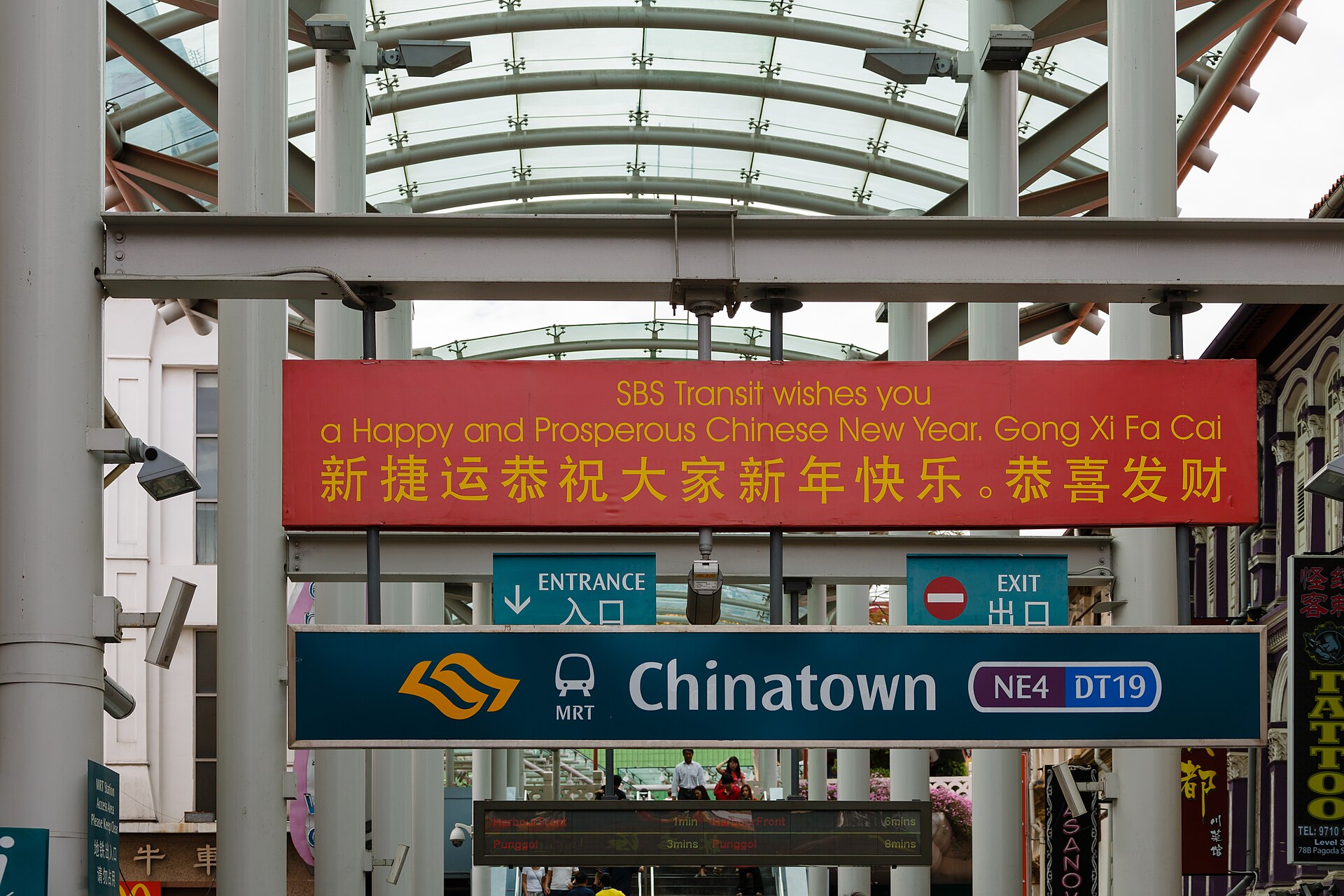
The MRT is the simplest way in. Chinatown station is an interchange on two lines — NE4 on the North East Line (purple) and DT19 on the Downtown Line (blue) — so it’s a direct or one-change ride from most parts of the city. On the North East Line it sits between Outram Park and Clarke Quay; on the Downtown Line, between Telok Ayer and Fort Canning. Trains run every few minutes from early morning to around midnight.
Coming from Changi Airport, take the MRT and change at Outram Park or Tanjong Pagar onto a line that stops at Chinatown; a Grab from the airport is faster if you’ve got luggage. From Marina Bay or the CBD it’s only a few minutes away.
Which exit for what
The station has several exits, and picking the right one saves you a loop:
- Exit A: Pagoda Street — the one you’ll want most. It opens straight onto the pedestrian street market, with the Heritage Centre, the temples along South Bridge Road and the food streets all a short walk away.
- Exits C & F: step-free with lift access.
- Exit E / underground Exit G: the New Bridge Road side, with Exit G linking directly into Chinatown Point mall.
One thing worth knowing: Maxwell Food Centre is actually closer to Maxwell MRT (TE18) on the Thomson–East Coast Line (brown) than to Chinatown station — though it’s an easy walk from either, so don’t overthink it.
Fares, passes & when trains run
MRT and bus fares are distance-based and cheap — a typical ride across town is only a couple of dollars. Just tap in and out with a contactless bank card or your phone (SimplyGo), or buy an EZ-Link card. If you’re sightseeing hard across the island, the Singapore Tourist Pass offers unlimited rides for a day or more — though for a Chinatown-based trip, pay-as-you-go is usually enough since you’ll walk most of the district anyway. Trains run from roughly 5.30am until around midnight; if you’re out late in the bars around Keong Saik, note the last trains leave close to 11.30pm, after which it’s night buses or a Grab.
By bus or Grab
If you’d rather stay above ground, plenty of buses run along Eu Tong Sen Street, New Bridge Road and South Bridge Road, which frame the district. For short hops, or when you’re loaded with shopping or it’s pouring, a Grab or taxi is cheap and quick — Chinatown’s central location means most rides across town are short.
Getting around on foot
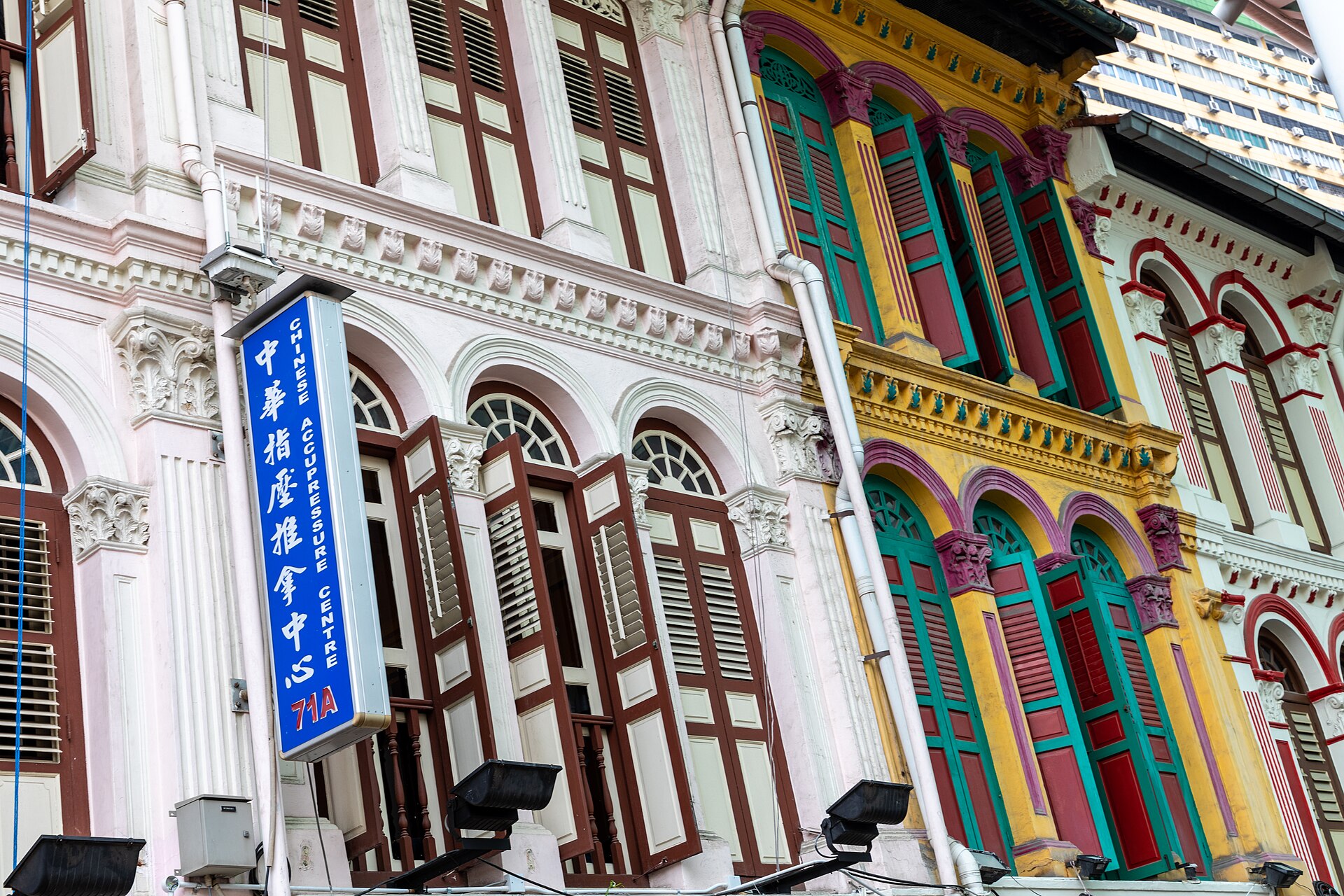
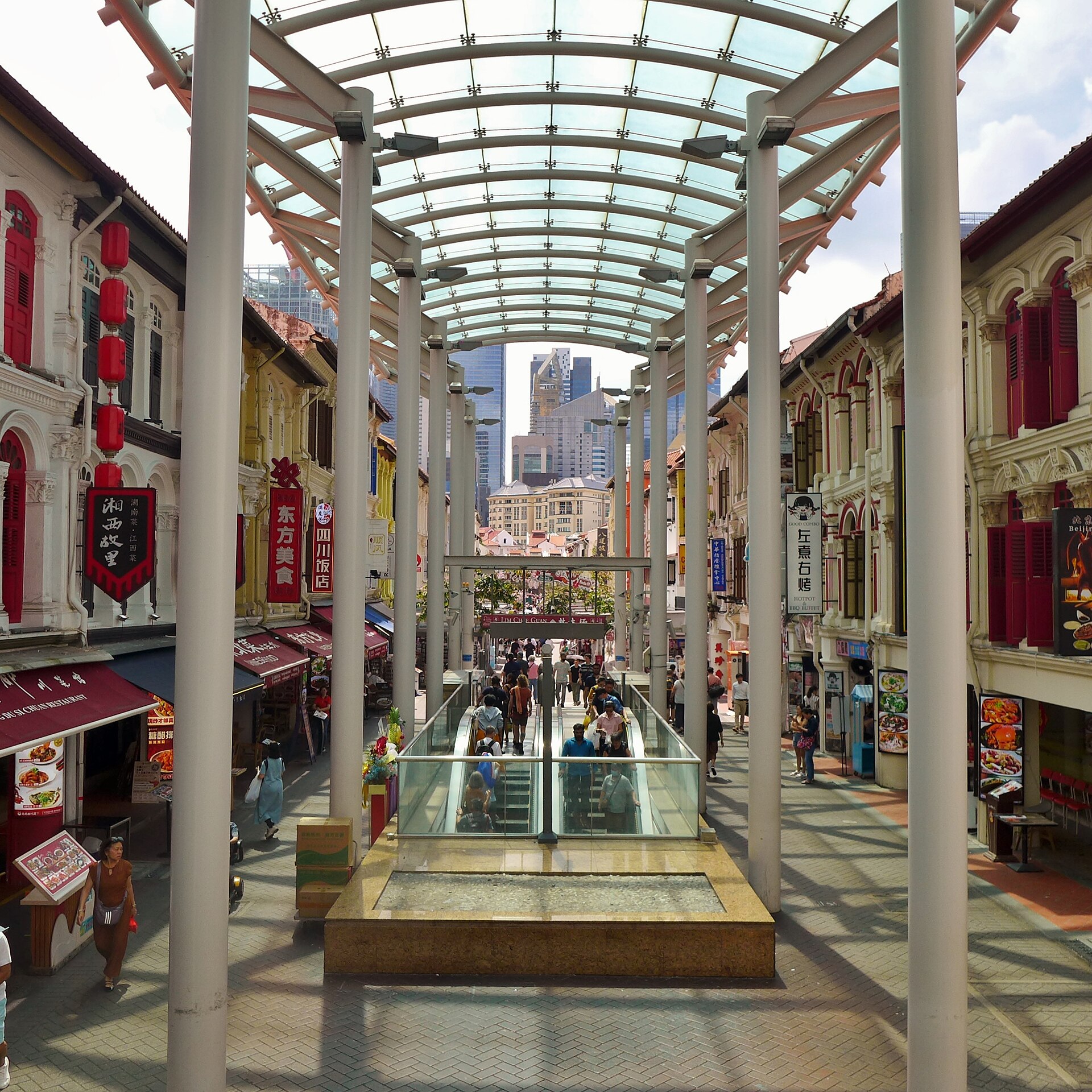
Once you’re here, walk. Chinatown is compact and flat, and wandering is half the fun — the pedestrianised Pagoda, Trengganu and Smith streets, the temples along South Bridge Road, and the murals and side lanes in between are all just minutes apart. There’s no need for transport within the district itself.
To get your bearings, picture the area framed by three parallel roads — New Bridge Road, Eu Tong Sen Street and South Bridge Road — with the pedestrian market streets running between them. Orient to those and you won’t get turned around.
Staying in the middle of it helps most. Rucksack Inn keeps a hostel near Chinatown MRT in a restored heritage shophouse on Temple Street, so you can cover the whole district on foot and hop the train only when you want to head further afield. Budget bunk dorms, luggage drop and a central location make it an easy base if getting around without fuss is the priority.
Practical tips for getting around
- Dodge the crush: weekday MRT peaks (around 8–9am and 6–7.30pm) are packed; off-peak is far more pleasant.
- Comfortable shoes: you’ll cover a lot on foot, and shophouse five-foot-ways can be uneven.
- Pack an umbrella: tropical downpours arrive fast and pass quickly.
- Get the apps: Grab for rides, plus a transit app for live train timings.
- Carry small cash: many hawker stalls and market sellers are cash-only.
Walking to nearby districts
Part of Chinatown’s appeal is how much sits within walking distance, from Telok Ayer and Tanjong Pagar to the river and bay:
- Telok Ayer & Amoy Street: about 5–10 minutes east, for heritage temples and hawker food.
- Tanjong Pagar: roughly 10 minutes south, for restaurants and bars.
- Clarke Quay & the river: about 10 minutes north.
- Marina Bay & the CBD: around 15 minutes on foot.
- Outram Park: the next interchange (East–West, North East and Thomson–East Coast lines), an easy walk or one stop away.
An easy base for the rest of Singapore
Because Chinatown sits on two MRT lines and within walking distance of the river and the bay, it’s one of the most convenient places to base a whole Singapore trip — not just for the district itself. Gardens by the Bay, Marina Bay Sands, Clarke Quay and the CBD are all a short ride or stroll away, and Changi Airport is a straightforward MRT journey. Staying here means less time commuting and more time exploring — start with a full day in Chinatown, whether you’re in town for two days or a week.
Quick answers
- Nearest MRT to the street market & Heritage Centre? Chinatown MRT, Exit A onto Pagoda Street.
- Nearest MRT to Maxwell Food Centre? Maxwell MRT (TE18), or a short walk from Chinatown MRT.
- Nearest MRT to the Ann Siang / Club Street bars? Chinatown or Maxwell, then a five-minute walk uphill.
- Step-free exits? Exits C and F have lifts.
Accessibility
For step-free access, use Exits C and F (both have lifts), and the underground Exit G has a wheelchair lift into Chinatown Point. The main market streets are flat and pedestrianised, though some older shophouse shopfronts have a step or two. If you’re keeping costs down while you explore, our guide to exploring Chinatown for under $50 shows how far a small budget stretches here.